Study Hub

Guidance, reading lists, and context for FE and HE students exploring war, security, and geopolitics.
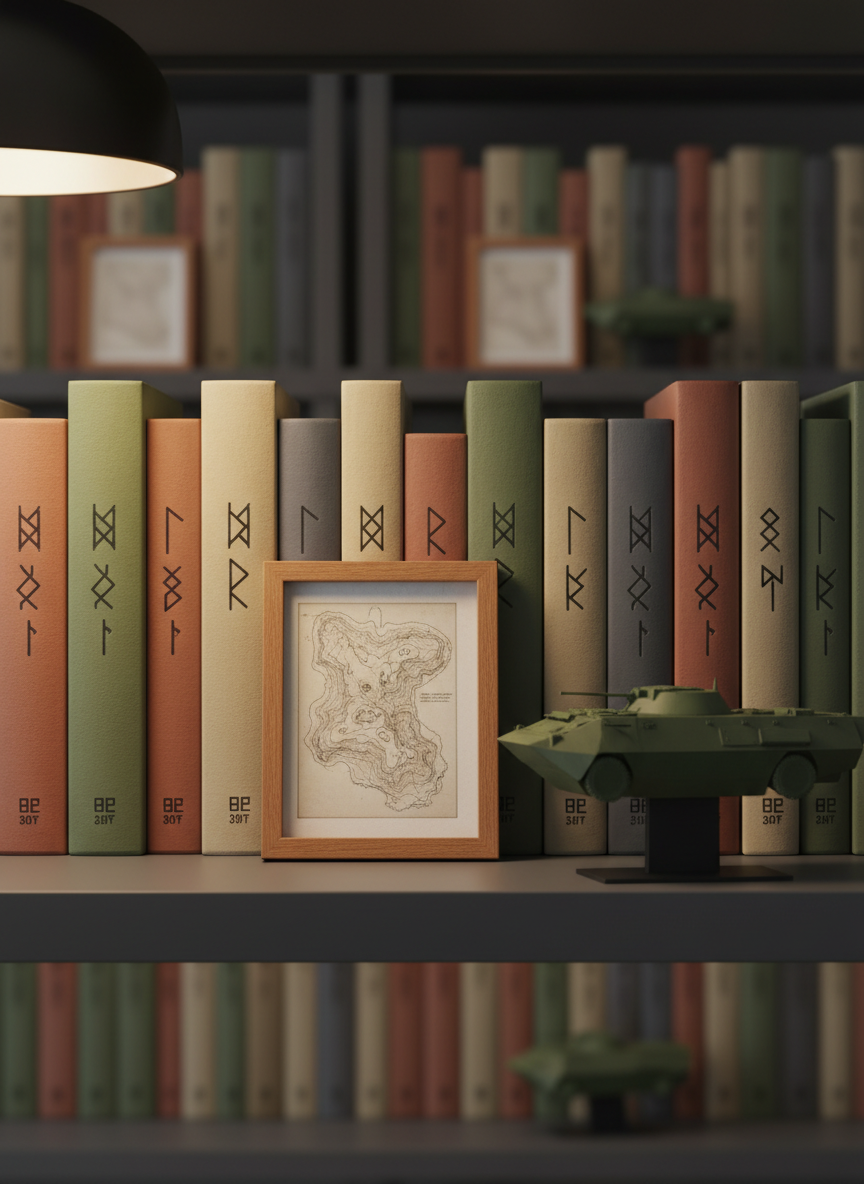
A close-up, photographic view of a carefully arranged shelf of non-branded military history and war studies volumes, their spines in muted earth tones with abstract symbols instead of text. Between the books rests a small, framed terrain sketch of a battlefield and a scale, unmarked model of a cold war-era armored vehicle in matte green. Soft, warm lamplight from the left creates gentle gradients across the book spines and a slight gleam on the model’s angular surfaces. Shot at eye level with a shallow depth of field, the foreground details are crisp while the background shelving blurs into understated tones. The mood is scholarly and authoritative, suggesting deep expertise in military history, geopolitics, and strategy, with a modern, professional aesthetic.
A pristine, unfolded topographic map of a mountainous border region lies flat on a rugged wooden field desk, its contour lines and shaded relief rendered in muted, realistic colors. Beside it sit a metal military-style compass, a weathered waterproof notebook closed with an elastic band, and a non-branded olive-green GPS device. Diffused overcast daylight from a nearby tent opening creates soft, directional light, highlighting the map’s texture and subtly catching on the metallic compass rim. Shot from directly above with sharp focus throughout, the composition feels ordered and methodical. The atmosphere is calm but purposeful, evoking outdoor leadership, backwoods navigation, and the geographical foundations of military decision-making, all in a clean, photographic, documentary style.

Linked Learning for Every Module

Use this blog to deepen seminar discussions, access curated sources, and revisit key concepts from uniformed public services, geopolitics, and military history modules, all organised alongside syllabi and assessment points.

Enquiries

Get in touch to discuss guest lectures, seminar support, curriculum design, or bespoke sessions for your students or staff.

Available for UK-based work

← Back

Thank you for your response. ✨

A large, detailed sand-table style terrain model fills the frame, sculpted with ridges, rivers, and miniature non-human markers representing armored columns and defensive positions. It sits on a matte, dark briefing-room table surrounded by blurred map tubes, closed laptops, and neatly stacked field manuals. Overhead fluorescent lights and a single cool-toned spotlight cast crisp, analytical shadows across contour lines and elevation features. Photographic realism from a slightly elevated angle emphasizes depth and strategic vantage points, with sharp focus on the central ridgeline and softer focus toward the edges. The mood is professional and analytical, conveying war studies expertise, operational planning, and serious academic rigor without showing any human presence.

Testimonials

A close-up, photographic view of a carefully arranged shelf of non-branded military history and war studies volumes, their spines in muted earth tones with abstract symbols instead of text. Between the books rests a small, framed terrain sketch of a battlefield and a scale, unmarked model of a cold war-era armored vehicle in matte green. Soft, warm lamplight from the left creates gentle gradients across the book spines and a slight gleam on the model’s angular surfaces. Shot at eye level with a shallow depth of field, the foreground details are crisp while the background shelving blurs into understated tones. The mood is scholarly and authoritative, suggesting deep expertise in military history, geopolitics, and strategy, with a modern, professional aesthetic.

Hope D.

Martyn’s modules connect theory, history, and current conflict in a way that finally made geopolitics click for me.

A pristine, unfolded topographic map of a mountainous border region lies flat on a rugged wooden field desk, its contour lines and shaded relief rendered in muted, realistic colors. Beside it sit a metal military-style compass, a weathered waterproof notebook closed with an elastic band, and a non-branded olive-green GPS device. Diffused overcast daylight from a nearby tent opening creates soft, directional light, highlighting the map’s texture and subtly catching on the metallic compass rim. Shot from directly above with sharp focus throughout, the composition feels ordered and methodical. The atmosphere is calm but purposeful, evoking outdoor leadership, backwoods navigation, and the geographical foundations of military decision-making, all in a clean, photographic, documentary style.

Hope D.

His field experience in navigation and survival gives real credibility to every lesson on terrain, risk, and military planning.

A large, detailed sand-table style terrain model fills the frame, sculpted with ridges, rivers, and miniature non-human markers representing armored columns and defensive positions. It sits on a matte, dark briefing-room table surrounded by blurred map tubes, closed laptops, and neatly stacked field manuals. Overhead fluorescent lights and a single cool-toned spotlight cast crisp, analytical shadows across contour lines and elevation features. Photographic realism from a slightly elevated angle emphasizes depth and strategic vantage points, with sharp focus on the central ridgeline and softer focus toward the edges. The mood is professional and analytical, conveying war studies expertise, operational planning, and serious academic rigor without showing any human presence.

Hope D.

As a fellow lecturer, I value Martyn’s rigor, clear expectations, and his commitment to developing resilient, reflective public service professionals.

A close-up, photographic view of a carefully arranged shelf of non-branded military history and war studies volumes, their spines in muted earth tones with abstract symbols instead of text. Between the books rests a small, framed terrain sketch of a battlefield and a scale, unmarked model of a cold war-era armored vehicle in matte green. Soft, warm lamplight from the left creates gentle gradients across the book spines and a slight gleam on the model’s angular surfaces. Shot at eye level with a shallow depth of field, the foreground details are crisp while the background shelving blurs into understated tones. The mood is scholarly and authoritative, suggesting deep expertise in military history, geopolitics, and strategy, with a modern, professional aesthetic.

Hope D.

Seminars on terrorism and security are challenging but supportive, encouraging difficult questions and critical thinking without ever sensationalising sensitive topics.